Don't be afraid of powerful modules
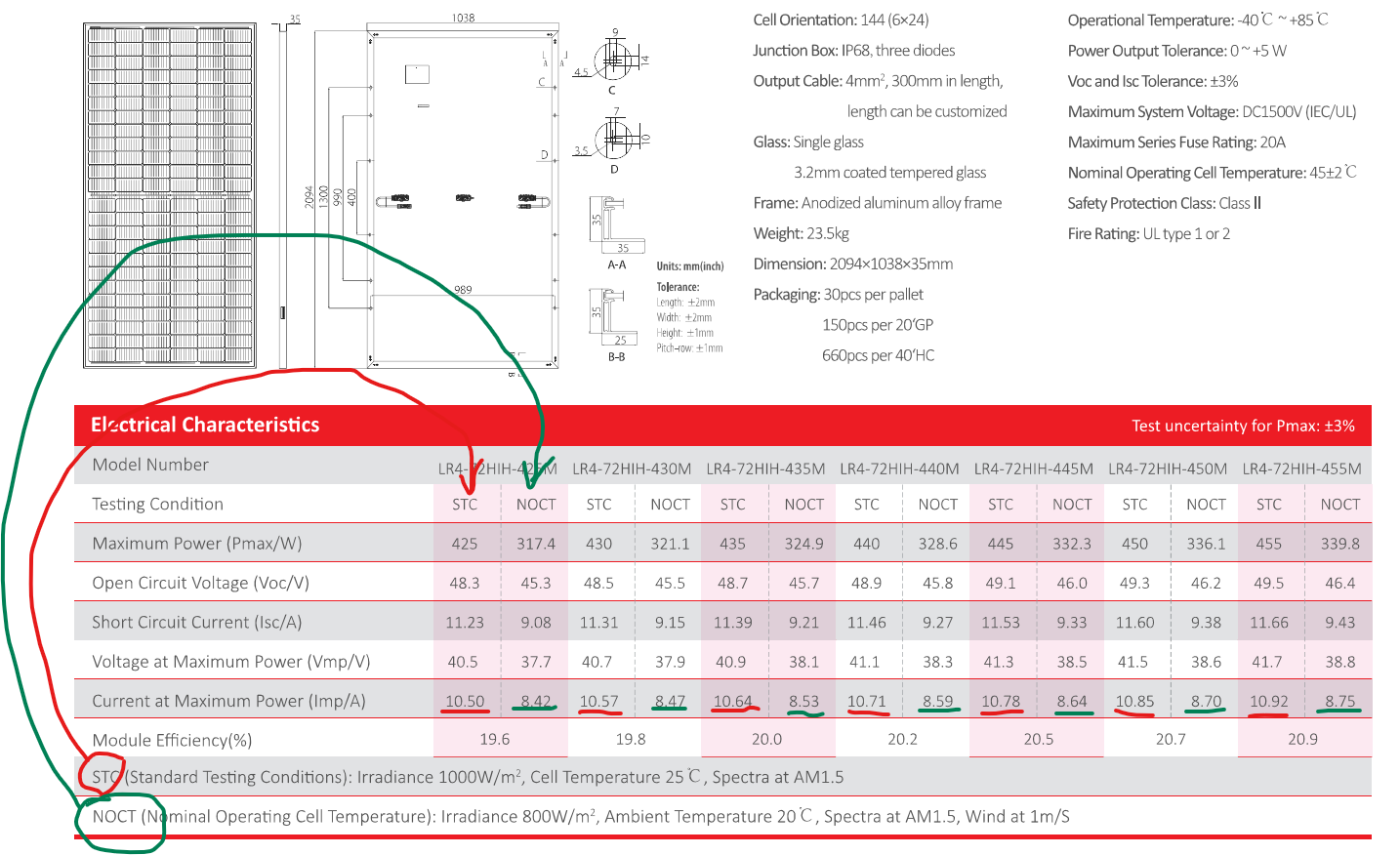
That’s true that current limitation of Solar Kerberos is 9A but still it isn’t a problem. In recent years, high-performance photovoltaic panels have appeared on the market, where the manufacturer states the ability to generate currents of up to around 11A.
Don't worry - there is no danger for several reasons.
REASON NO.1:
It is necessary to understand correctly the numbers referring to panels. Two different parameter tables can be found in the panel data sheet - one abbreviated STC and the other called NOCT (or sometimes NMOT). These abbreviations indicate the measurement conditions under which the parameters were measured.
STC = Standard Testing Conditions say that the panel was measured at irradiance 1000 W/m2, temperature of + 25 ° C and a light spectrum expressed as AM = 1.5. The measurement is performed on a flash device called "flasher" that can maintain the temperature of + 25 ° C at such a high intensity of radiation. With longer lighting of the panel, it would heat up quickly and the parameters would change. In other words, STC are artificial, laboratory conditions, almost unattainable in nature. Therefore, the performance of panels is also given in Wattpeak (Wp) units - a peak value measured under standardized conditions, under which the panels are measured by all manufacturers and test laboratories.
NOCT = Nominal Operating Cell Temperature (or NMOT = Nominal Module Operating Temperature) are conditions simulating reality and are defined as irradiance 800 W/m2, ambient air temperature of + 20 °C, wind speed of 1 m/s and spectrum AM = 1.5.
So, realistically in natural conditions, panels are able to generate values according to the table measured under NOCT (NMOT) measurement conditions.
Furthermore, the difference between the values of Isc and Imp must be understood.
Isc = I short circuit (short circuit current – current at zero ohm load). This current is able to generate a short circuit in the module, i.e. when you connect the positive output of the panel directly to the negative one. It is certainly an interesting value, it tells us how "strong" the module is, in practice this value is used, for example, to dimension the fuse - but a short circuit module is a fault condition that should not occur. So, if the panel has Isc current higher than 9A, it still says nothing in relation to Solar Kerberos device.

Imp = I maximum power point. This parameter measured at NOCT is the correct one, which should be of interest in relation to Solar Kerberos (and any other MPPT inverter). Because the main job of the Kerberos inverter is to keep the modules loaded so that the operating point is at the point of maximum power, i.e. that the modules are optimally loaded for the current exposure, temperature and other conditions that affect the performance of PV modules.
REASON NO.2:
Even if PV modules with Imp higher than 9A appear on the market, there is no danger either for Kerberos or for the modules, because Solar Kerberos inverter itself regulates the flowing current.
REASON NO.3:
It might only very rarely happen that modules would not be used to 100 % and current would be limited to 9A. But again, it should not be a significant loss, because such peak conditions are only for a short, statistically inconsiderable time.